


Tree slices with engraving: ideas, materials, and care
You are looking for a gift that feels personal but does not look like a quickly printed standard item. A gift voucher feels too vague, while a photo alone may seem too smooth. Then your eye falls on a tree slice with engraving: a piece of wood with growth rings, a natural edge, and a message tailored precisely to a person or occasion.
To keep it from becoming just another decorative piece, you should consider three things together: the behavior of the wood, the engraving technique, and the length of the design. An experienced workshop master would not first ask which motif looks appealing right now. She would first check which surface, wood structure, and lettering will remain legible over time.
Table of contents
- When a tree slice says more than any gift voucher
- What a tree slice actually is and which wood is used
- These engraving techniques are used on wood slices
- Which texts, names, and motifs fit on a tree slice
- How to keep an engraved tree slice beautiful for years
- Gift ideas with wooden discs for special occasions
- Frequently asked questions about engraved tree slices
When a tree slice says more than any gift voucher
You may be standing in a shop or scrolling through gift ideas. First, a gift voucher lands in the cart, then a beautiful photo, followed by a small pendant. Everything is useful, but nothing feels connected to your shared story. A tree slice can bridge exactly this gap because it not only carries a message, but already has character of its own.
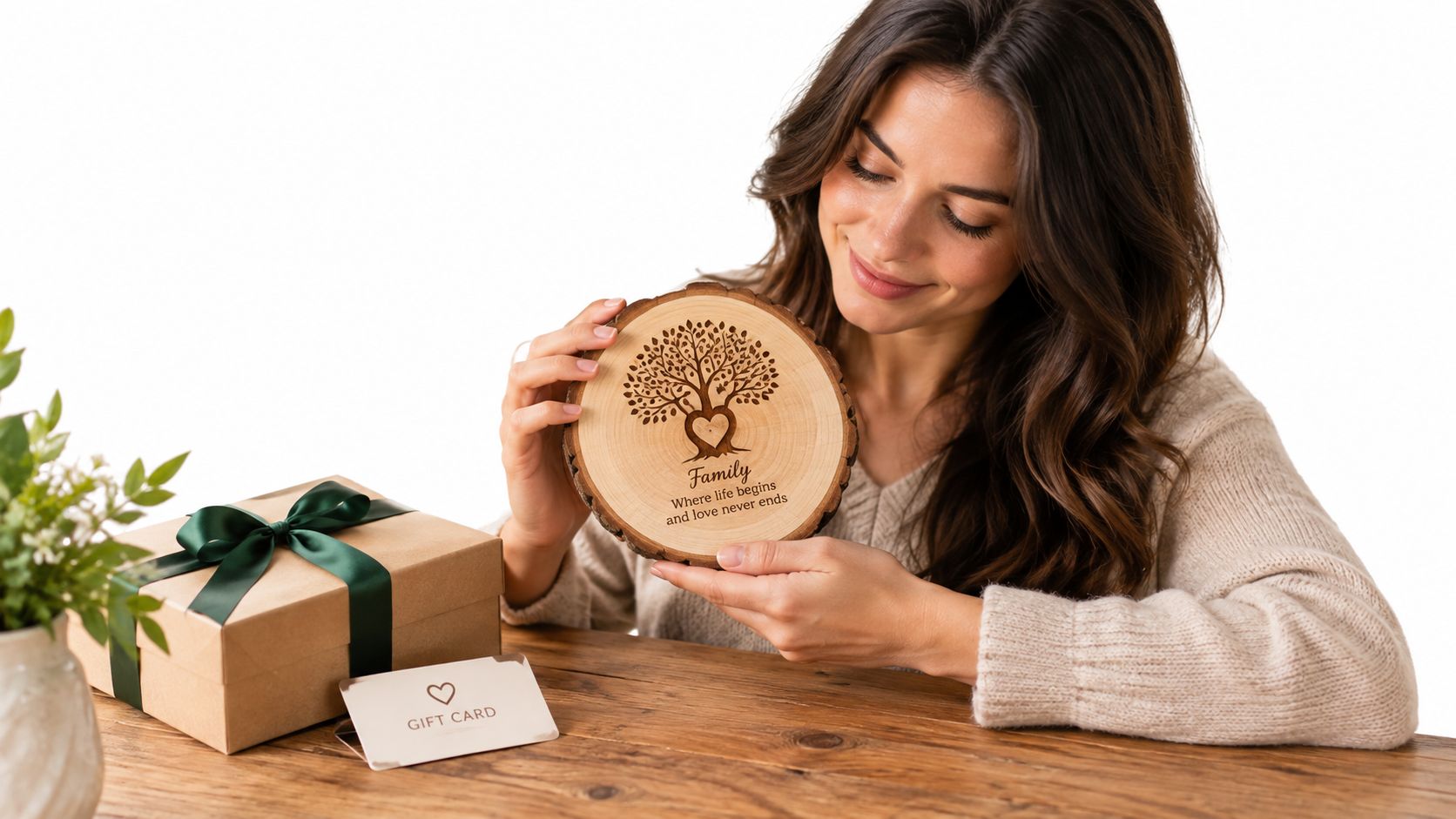
A tree slice is a horizontal cross-section of a trunk. The growth rings, bark, and irregular outer edge make every piece unique. Even when two slices come from the same type of wood, they differ in color, knot pattern, and ring formation. This makes the gift feel less industrially uniform and more like a found object selected for a particular person.
The engraving should not hide these characteristics. A short name can sit calmly between the growth rings, a date can bring order to the natural structure, and a simple symbol can add a personal memory. Too much text, on the other hand, covers the surface and competes with the grain. Wood is not a blank sheet of paper, but more like an open book whose pages have already been written on.
Workshop rule: The engraving should make the story of the wood easier to read, not cover it completely.
That is precisely why it is worth taking a close look at the material. Anyone who understands why wood moves and why a laser line looks different on a slice than on a smooth wooden board can assess both design and care much better.
What a tree slice actually is and which wood is used
A wood slice is created when a trunk is sawn across the direction of growth. The wood must then dry sufficiently before it can be engraved and used as decoration. The slice may retain its bark or be sanded without bark. With bark, it looks more natural; without bark, it can usually be hung, labeled, and cleaned more easily.
As a rough guide, diameters between 15 and 35 centimeters and thicknesses of around 1.5 to 4 centimeters are common. These dimensions are not a fixed standard, but they help provide an idea: A small slice fits on a shelf, while a larger one becomes wall décor or the centerpiece of a memory wall. As the surface area increases, so does the space for lettering, symbols, and a balanced border.
Imagine the growth rings as the pages of an open book. The grain runs across the wood like lines across the paper, while knots look like distinctive insertions. An engraving cannot be placed independently of this. It has to fit into these lines; otherwise, even technically clean lettering will look uneven.
Wood types compared directly
| Wood type | Hardness | Grain | Color | Suitability for engraving |
|---|---|---|---|---|
| Birch | rather soft | fine and calm | light, slightly warm | Very good for clear lettering and fine symbols |
| Beech | medium-hard to hard | even, dense | light to reddish | Good for clean lines and structured designs |
| Oak | hard | distinctive and full of character | beige to warm brown | Good for bold lettering; fine details may appear less uniform |
| Spruce | soft | longitudinally pronounced, knotty | light | Suitable for rustic, easily readable designs |
| Applewood | medium-hard | lively and decorative | warm, reddish | Beautiful for individual designs, but requires careful placement |
Drying determines the wood's later stability. As a hygroscopic material, wood responds to moisture and releases it again. If a slice is dried too quickly or insufficiently, warping and cracks may become more likely. When choosing one, you should therefore look for a flat back, stable bark, and material that appears dry overall.
There is a long-term standardized official data basis for German woodworking. According to background information on reports and statistics from Holzbau Deutschland, the primary survey of woodworking has been conducted annually since the 2007 reporting year. This does not indicate the quality of an individual wood slice, but it places such products within a documented area of wood processing spanning many years.
These engraving techniques are used on wood slices
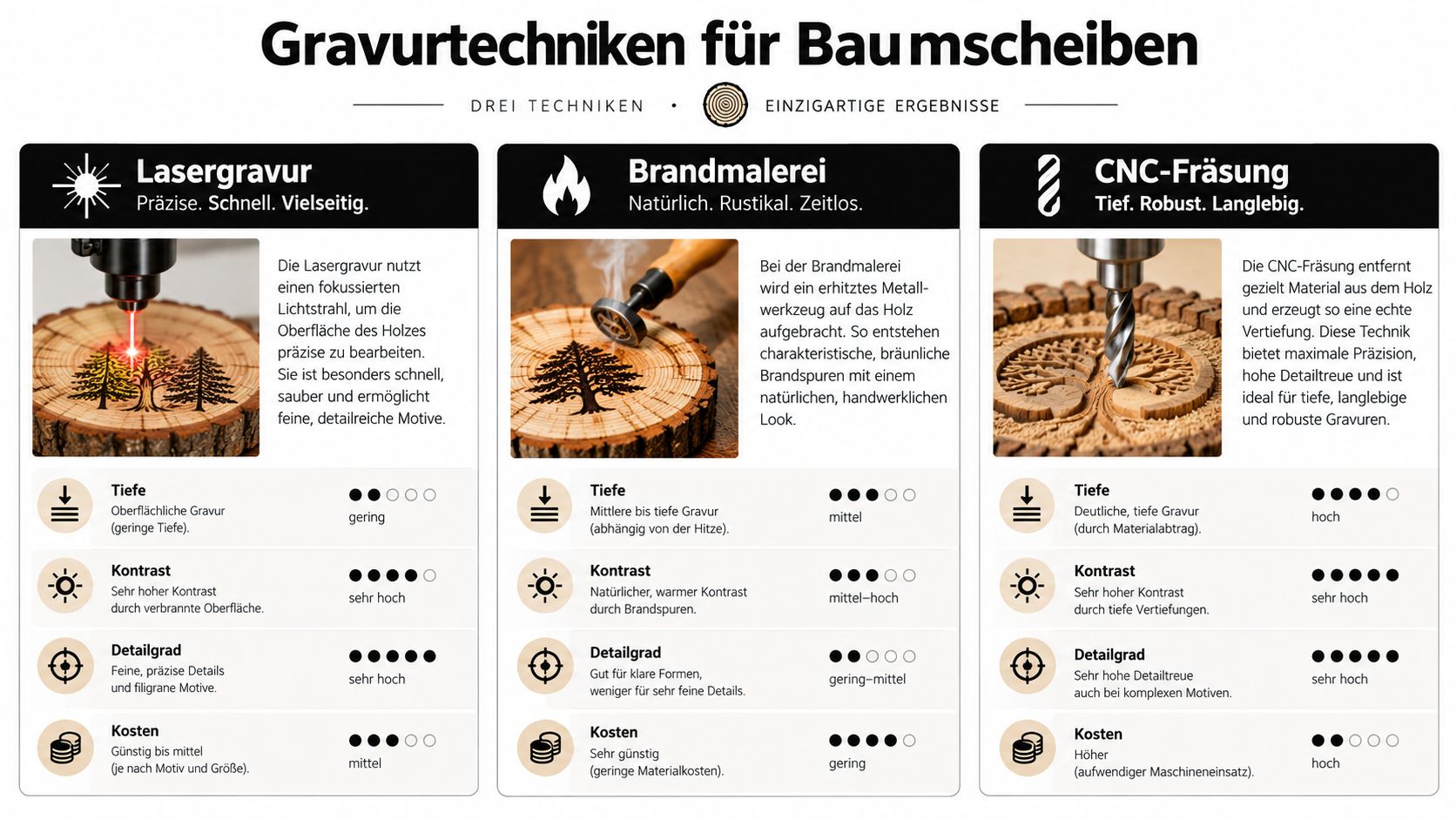
You will encounter three processes particularly often: laser engraving, pyrography, and CNC milling. They do not create the same effect, even though all three allow for personalized lettering. The right choice depends on whether you prefer fine lines, a warm handcrafted impression, or a tactile relief.
With laser engraving, a focused beam of light moves across the surface. In wood, this creates thermal darkening, usually in shades ranging from brown to black. The engraving is therefore normally not applied in color. Grain, hardness, and density influence how dark and uniform individual areas become. In practice, laser engraving on wood and its visual characteristics are implemented on different laser systems accordingly. CO2 lasers are suitable for surfaces and cuts, while blue diode lasers are suitable for fine details and photo engravings.
Pyrography also uses heat, but it is done by hand. A heated tip draws lines into the wood. This creates a warmer and slightly irregular character that is particularly well suited to handwritten names, small illustrations, and rustic gifts. The result depends more heavily on the hand of the person carrying out the work, whereas a laser can reproduce digital templates very consistently.
In CNC milling, a rotating tool removes material. The groove is perceptible, often deeper and more pronounced than a laser line. This suits large letters, coats of arms, or reliefs, but can quickly appear heavy on small surfaces. Soft woods can be processed quickly, while hard woods produce a different milling pattern and require careful tool guidance.
Which technique suits which motif
- Laser engraving: Ideal for clear names, coordinates, logos, line drawings, and finely graduated image templates. The surface remains largely flat; the effect is created through contrast.
- Pyrography: Suitable for a personal, not entirely uniform look. Handwriting and organic symbols look especially authentic when slight variations are desired.
- CNC milling: Suitable for bold reliefs and motifs that should not only be seen but also felt. Very small lettering is less suitable because the grooves quickly crowd together on a limited surface.
The smell and material handling also differ. With laser engraving and pyrography, the heat produces a characteristic burnt-wood smell, while milling produces shavings. Depending on the process, the surface must then be cleaned, sanded, or sealed.
If you are also looking for a small personalized wooden detail, taking a look at key rings with guardian angel engraving can help with choosing a motif. A small symbol that works on a key ring can be carried over as an element onto a larger tree slice.
Which texts, names, and motifs fit on a tree slice
The most beautiful idea fails if it cannot be read from a distance. A tree slice does not have an even surface like a sheet of paper. Tree rings run through the lettering, the bark defines the edge, and a branch may lie exactly where a letter was originally planned.
So start with the visible area, not the text. Mentally mark out a calm inner area and check whether the lettering has enough distance from the rings and the edge there. A name such as “Mara” or “Jonas” is usually easier to accommodate than a long dedication. A date, initials, or a short place name can supplement the message without overcrowding the wood.
The readability logic in four decisions
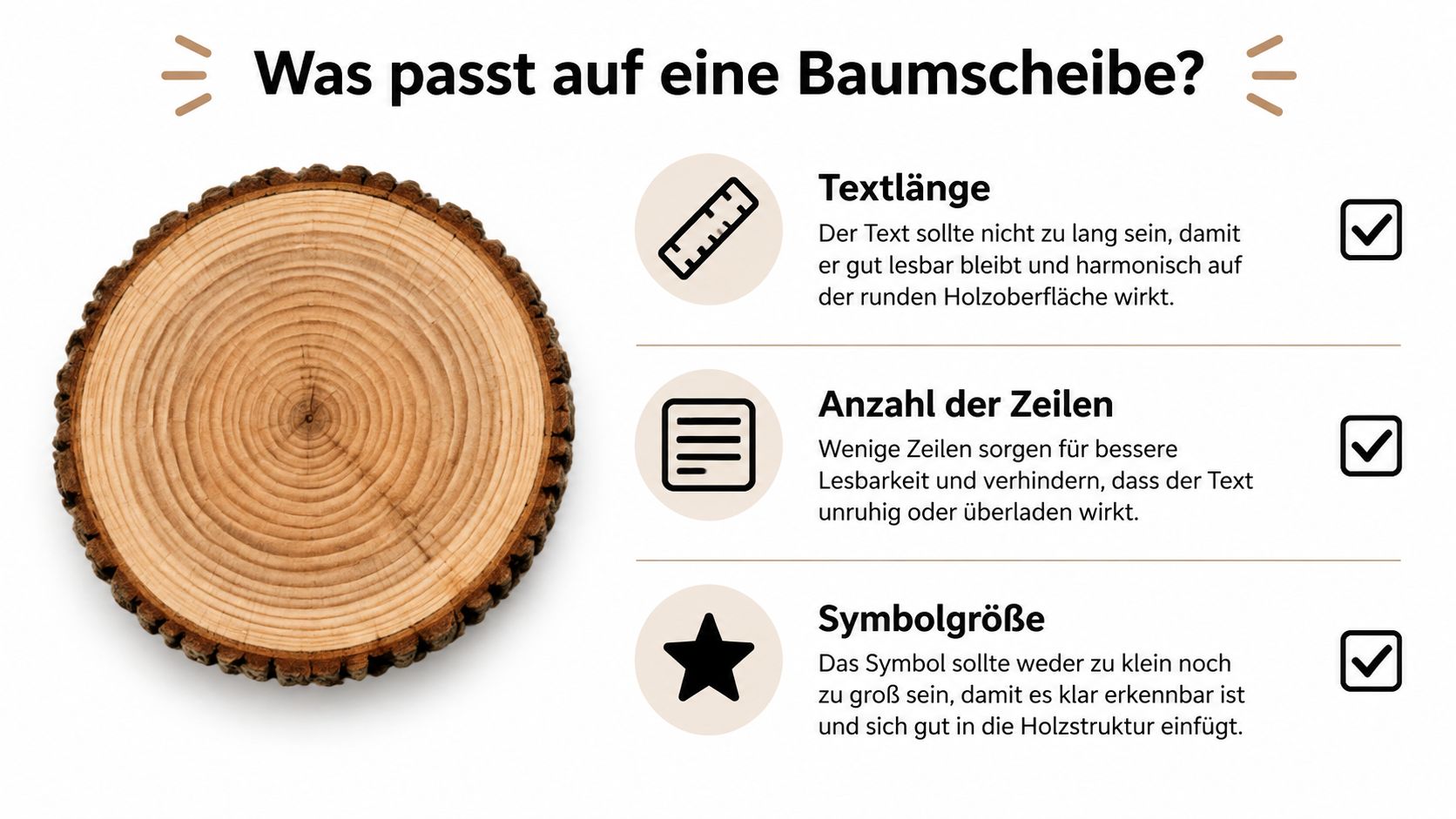
- Few words per line: Three to six words per line often look more balanced than a long sentence because the line does not have to be pushed right up to the natural edge.
- Limited number of lines: Up to three lines leave the tree rings and edge visible. More text usually requires a larger, calmer slice or significantly smaller lettering.
- Clear shapes: Bold, simple letters and symbols withstand the changing surface better than very fine script fonts.
- One main motif: A heart, a tree of life, a constellation, a mountain silhouette, or a family emblem should support the message. Several small symbols can quickly compete with one another.
Coordinates can be a good alternative to a long description of a location. A short hand-drawn sketch or a scanned symbol often feels more personal than an overloaded image. With handwriting, however, the original should have strong contrast and not be too thin. The workshop carrying out the engraving may need to adjust the lines so that they do not disappear on the irregular surface.
Less suitable are biographies, very fine small print, and photos with many soft tonal transitions. A photo can work, but preferably as a clearly simplified image engraving with easily recognizable outlines. With a long text, small lettering is not automatically the solution. It may make the message fit, but not necessarily readable.
Practical test: Do not review the design only on a screen. Reduce it to the planned slice size and check whether the name, date, and symbol still appear as a cohesive unit.
How to keep an engraved tree slice beautiful for years
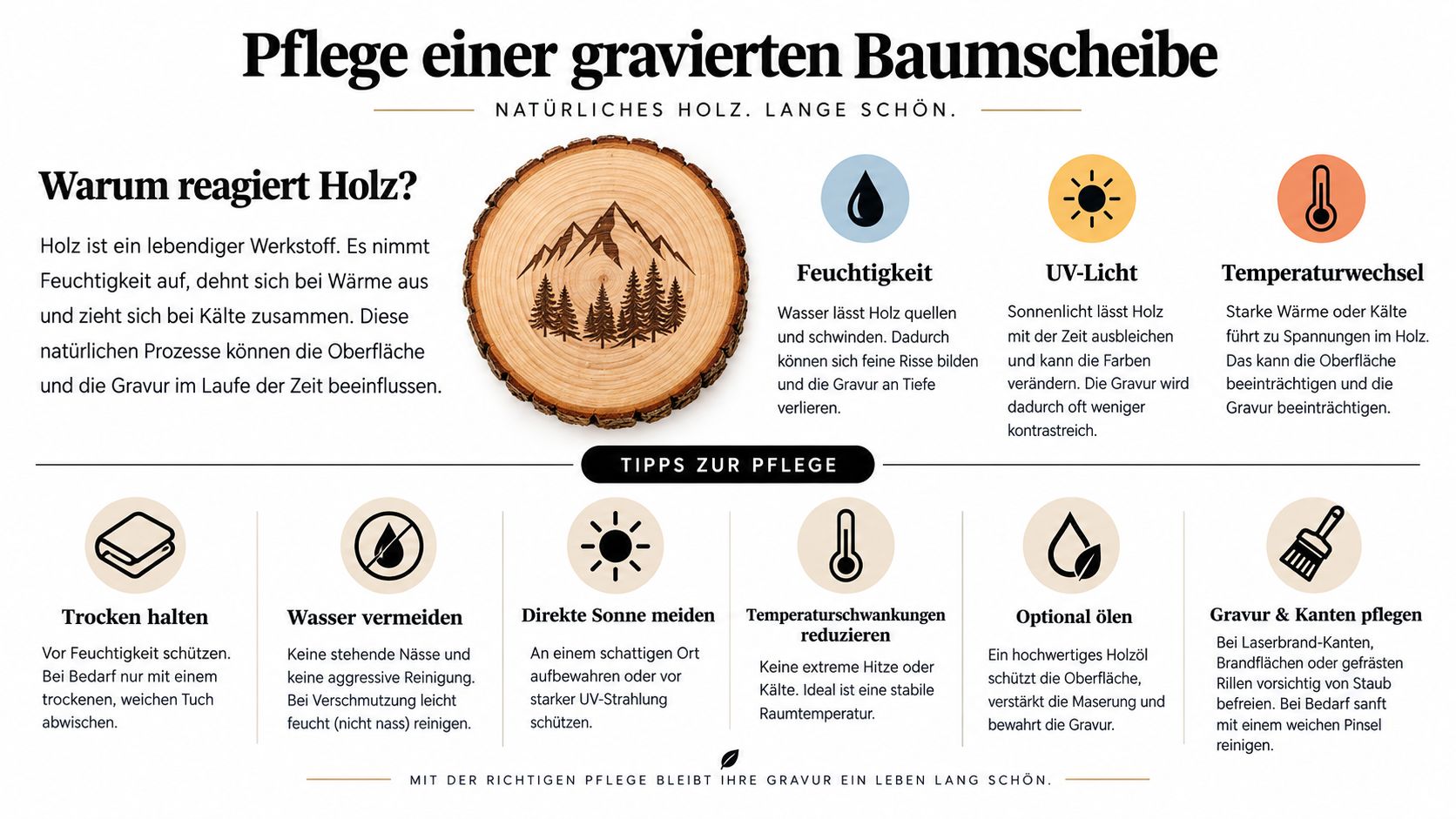
Wood changes because it absorbs and releases moisture from its surroundings. UV radiation and temperature fluctuations also play a role. The slice can warp or develop cracks, especially if it is kept permanently damp, exposed to strong sunlight, or moved abruptly from cold to warm conditions. This material reaction affects not only the back. A laser-cut edge, a burned surface, or a milled groove is also part of a material that continues to move.
The most important care is therefore quite simple: store it in a dry, well-ventilated, and protected place. The storage recommendations for engraved tree slices likewise advise keeping them in a well-ventilated place without constant moisture or strong sunlight, as explained in the care instructions for tree slices.
What causes damage in everyday use
- Wiping with a damp cloth: A slightly damp cloth can be used if necessary, but the surface must then dry completely. Do not soak it.
- Dishwasher and standing water: A tree slice does not belong in the dishwasher and should not be used as a permanently wet base.
- Proximity to heating: Direct, dry heat can cause the wood to expand and contract more intensely. A spot in front of a radiator is therefore unsuitable.
- Harsh cleaners: Abrasive products and strong household cleaners can damage the surface, protective coating, and color effect of the engraving.
- Prolonged sunlight: Light wood can change, and the engraving may look different over time depending on the surface.
For regular care, a soft, dry cloth is usually sufficient. If necessary, you can use a slightly damp cloth without harsh additives and then wipe the surface dry immediately. Re-treatment with a suitable wood oil or hard wax may be useful at longer care intervals. The important thing is that the product matches the existing surface and is not simply applied to an unknown sealant.
A simple care routine
In everyday use, you can remove dust with a soft cloth. During seasonal cleaning, check the edge, back, and hanging fixture for moisture or new stress cracks. If the surface looks dry and dull, first check which oil or wax has already been used before refreshing it.
Similar principles apply to small personalized companions, even though they are touched more frequently. You can find tips on suitable engraving and handling such a gift in engraved keychains for men. The wooden disc itself stays beautiful longest if you do not treat it like a functional object, but like a dry, natural-material home accessory.
Gift ideas with wooden discs for special occasions
A good gift does not result from considering the occasion, design, and packaging separately. The three elements must work together. A wedding usually calls for a calm, lasting design, while a farewell can benefit from more room for a personal message. The wooden disc feels cohesive when the material, lettering, and presentation tell the same story.
Wedding and a new beginning together
For a wedding, a medium-sized wooden disc with initials and the date is a good choice. A subtle heart or two interwoven lines can complement the design without covering the growth rings. A light wood with clear laser engraving looks understated, while a disc with visible bark feels more natural.
A simple wooden box or a suitable stand protects the gift when it is presented. A small card explaining the personal background of the engraving is enough as an accompanying item. More decoration would only distract from the natural surface rather than highlight what matters.
Birth and baptism
For a birth or baptism, the format can be smaller and the message more focused. A name, date of birth, and a single symbol, such as a star or a small tree, make for a harmonious combination. You should only add details such as the time or other personal information if the surface does not then look overcrowded.
For a smaller, portable gift, a personalized birth gift is also a possible addition. A wooden disc can hang in the child's room, while a small engraved object stays with the parents in everyday life.
Farewell and remembrance
A farewell gift often needs more text than a wedding gift, but not necessarily a larger area for the lettering. Instead, choose a larger disc with a short, personal dedication and make the name stand out clearly. A mount, a simple frame, or a sturdy stand gives the piece a permanent place.
For a company anniversary, a logo with the founding date works well on a wooden disc. The logo should be simplified if it consists of very fine lines. A deep engraving can suit a rustic business, while laser engraving looks more precise with clear graphic shapes.
Presentation without clutter
- Paper band: A narrow paper band explains the occasion and material without covering the wood.
- Stand: A wooden or metal stand is suitable for recipients who do not want to drill holes.
- Card: A handwritten message complements the engraving without burdening it with additional text.
- Packaging: A simple box protects the bark and edges during transport and makes unpacking more relaxed.
Frequently asked questions about engraved tree slices
Does the grain remain visible despite the engraving?
Yes, the grain usually remains visible, and that is precisely what makes it appealing. However, it can enhance or reduce the contrast of the engraving in places. With highly figured woods, the lettering should be bolder and the background as calm as possible. That is why the design is assessed in the workshop not only on a neutral screen but also on the intended type of wood.
Is a tree slice suitable purely as decoration?
Yes, it can be used as wall art, a door sign, a shelf display, or a keepsake. It needs a suitable hanging system or a secure stand. With a slice that still has bark, you should not use the edge as a handle, as loose sections may come off. For kitchens and damp rooms, a protected, dry place is better than one directly near water.
What does the price depend on?
The price mainly depends on the type of wood, diameter, thickness, surface preparation, engraving technique, and the effort required to prepare the artwork. A short name on a small, flat slice requires less work than a logo, handwriting, or a prepared image file. Natural bark requiring extensive stabilization can also involve additional work. Before ordering, ask whether data preparation and a preview are included.
Can an engraving be corrected afterward?
A dark laser or wood-burned engraving cannot simply be erased. A CNC groove can sometimes be altered by further sanding or creating a new design, but this removes material and makes the surface smaller. The text should therefore be checked several times before processing. Names, dates, spelling, and special characters should be on the approval list before the workshop begins.
If you want to combine a personal wooden idea with a wearable engraving, OTANTO offers handcrafted jewelry and gift items personalized with names, dates, and selected photo and line engravings. Explore the options at OTANTO and choose an engraving whose scope suits the shape and occasion.


