


Buy a children's bracelet with a name: The 2026 guide
You are standing in front of a gift box and wondering whether a children's bracelet with a name should simply look beautiful or also serve a practical purpose in everyday life. For a christening, birthday, or first day of school, the jewelry may primarily preserve a memory. On outings, trips, or in the case of known allergies, however, a suitable engraving can make additional information visible. What matters, therefore, is not just the color and design, but also the material, fit, engraving, and the child's specific everyday needs.
Table of contents
- Why a personalized children's bracelet is more than just a gift
- These materials are suitable for children
- Understanding safety in children's jewelry
- Finding the right size for small wrists
- Choosing an engraving and inscription appropriately
- Suitable occasions for a children's bracelet with a name
- Care instructions and delivery times at a glance
Why a personalized children's bracelet is more than just a gift
A name bracelet can serve two very different purposes. As a keepsake, it bears a first name, a date, or a symbol commemorating a special family moment. As an identification bracelet, however, it can include a telephone number, a medical abbreviation, or an allergy alert.
Demand for personalized gifts in Germany shows why such pieces of jewelry are so popular. A 2020 consumer survey cited by Roland DG forecast a market of 2.7 billion euros for personalized gift items in Germany over the following twelve months. More than 2.2 billion euros was expected for holiday shopping at the time, while personalized gifts achieved an average 13% premium. Fashion jewelry and accessories were among the most popular categories, with 40% of respondents mentioning them, underscoring the importance of small personalized pieces of jewelry (Roland DG consumer survey on personalization).
The 2022 Pixum survey of more than 1,000 participants also shows a strong emotional connection. 83% preferred personalized gifts over conventional presents, and more than 92% themselves preferred giving individually designed gifts. Among 18- to 44-year-olds, approval was just under 90% (Pixum Gift Study 2022).
Practical decision: If the bracelet is primarily meant to serve as a keepsake, a name plus a symbol or date is often sufficient. If it is intended to provide support in an emergency, the engraving must enable a specific next step after being read aloud or read.
A first name alone does not uniquely identify a child, especially since many names are repeated. According to findings described in the German naming context, around half of children have a name from the top 110, which means that an additional contact detail or medical note may be more important for the safety function than especially decorative lettering. A name bracelet also does not replace supervision, medical documentation, or a professional emergency card. However, it can be a useful addition if the information is brief, up to date, and easy to read.
These materials are suitable for children
A bracelet for a child must fit their everyday life. If they wear their jewelry while playing, doing crafts, and washing their hands, different features matter than with a name bracelet worn only at family celebrations. The key factors are skin, use, and willingness to provide care. The material can also influence whether the bracelet is more of a keepsake, an everyday companion, or an easy-to-read identification aid.
925 sterling silver is suitable as a classic entry-level choice. It looks elegant, can be engraved well, and is generally more accessible than gold. Over time, silver can tarnish; a soft polishing cloth can help then. Since it is comparatively soft, active play can leave visible marks on delicate surfaces.
14-karat gold retains its color better and lasts a long time with proper care. It is suitable for a high-quality keepsake that is intended to be passed on later. The higher price and possible weight on a small wrist should be considered when making the decision.
Medical-grade stainless steel and titanium are suitable choices when a child prefers low-maintenance jewelry or reacts sensitively to jewelry. The specific alloy and verifiable material quality are crucial. A coating can change through friction. Therefore, the surface should be checked rather than relying solely on the material designation.
| Material | Skin tolerance | Care requirements | Price level | Recommendation |
|---|---|---|---|---|
| 925 sterling silver | Usually well tolerated with verified quality; individual reactions are possible | Polish gently and regularly | Moderate | For older children and special occasions |
| 14-karat gold | Skin-friendly when made from a suitable alloy | Low to moderate | High | As a long-lasting keepsake |
| Medical-grade stainless steel | Resistant and suitable for many sensitive skin types | Low | Low to moderate | For an active lifestyle and frequent wear |
| Titanium | Lightweight, durable, and often suitable for sensitive skin | Low | Moderate to high | For children with high material sensitivity |
| Gold-plated version | The surface may become more susceptible to abrasion | Gentle, regular care | Moderate | When appearance matters more than maximum abrasion resistance |
For babies and toddlers, a smooth, stable surface matters more than a particularly precious metal. Older children can wear silver or gold if they remove the bracelet during sports, bathing, and swimming. For a jewelry set, the guide to a personalized children's necklace provides additional guidance. Decide based on whether the piece is mainly intended to remain a keepsake or should be easy to read and durable enough for everyday use.
Understanding safety in children's jewelry
For children's jewelry that remains in continuous contact with the skin, nickel release under REACH is a key testing criterion. For bracelets, necklaces, and similar products, the limit is 0.5 µg/cm² per week. For jewelry that comes into contact with pierced skin, the limit is 0.2 µg/cm² per week. The Bavarian State Office for Health and Food Safety also explains that it is not only the nickel content that matters, but also the release rate, which is influenced by the alloy, coating, and abrasion (Information on jewelry and nickel under REACH).
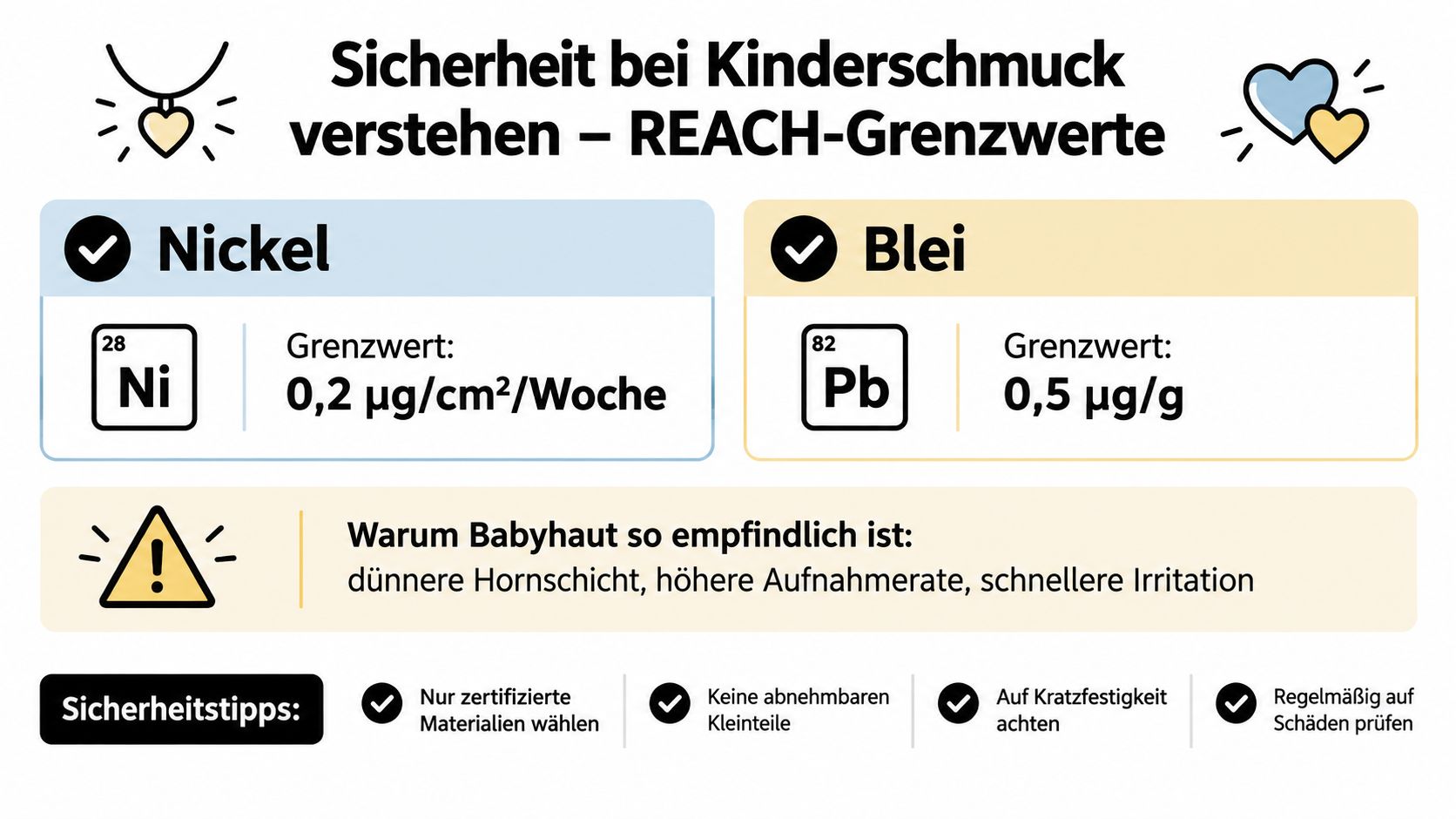
A coating that appears to be “nickel-free” is therefore not automatically problem-free. If it wears off at edges or heavily used areas, skin compatibility may change. Parents should look for complete material information, verifiable REACH compliance, and clear age recommendations.
Regionally tested products show that children's jewelry can be safe when manufactured under controlled conditions. In 2024, the Berlin-Brandenburg State Laboratory reported no contamination with heavy metals, plasticizers, or azo dyes in the metal children's jewelry and children's watches examined. All nickel levels met the legal requirements (2024 annual report of the Berlin-Brandenburg State Laboratory).
When shopping online, pay particular attention to:
- Material information: The specific metal or alloy should be stated.
- Compliance: References to REACH and available test documents must be easy to understand.
- Mechanics: Edges, loops, and clasps must not be sharp or loose.
- Small parts: Detachable charms and small beads can pose a risk to younger children.
- Times to remove it: The bracelet should be removed while sleeping, bathing, and playing sports.
Finding the right size for small wrists
A bracelet that is too tight rubs, presses, and leaves marks. A model that is too loose, on the other hand, can slip over the hand or get caught on playground equipment. Therefore, always measure the actual wrist and do not rely solely on the shop's age recommendation.
Place a flexible measuring tape directly over the wrist bone. It should fit snugly without cutting into the skin. Then add about 1 to 1.5 cm of movement room, depending on the desired fit. This extra space allows for movement but should not cause the bracelet to hang loosely around the forearm.
The following lengths are often used as a rough guide:
- Infants: approximately 12 to 13 cm
- Toddlers: approximately 13 to 14 cm
- School-age children: approximately 14 to 15 cm
These values are only starting points. A slim wrist, a sturdy clasp, or a rigid pendant can change the appropriate length. For a gift without a prior fitting, an adjustable model with chain links or a suitable sliding clasp is usually more flexible. A fixed length fits more precisely but leaves less room for growth.
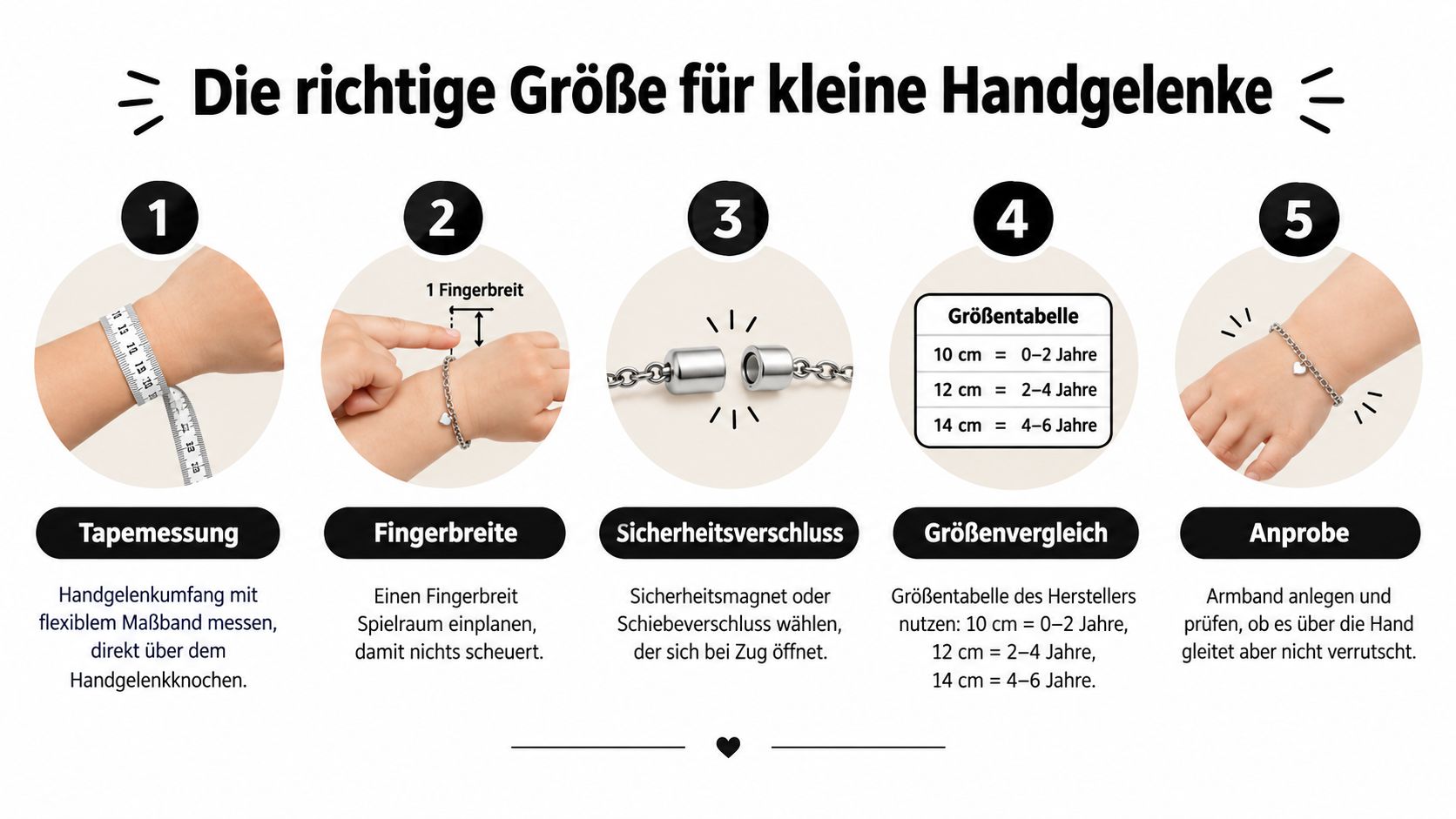
Fit test: The bracelet should be able to move without pressing into the skin. At the same time, it must not be so loose that it slides over the hand during normal movement.
Check the clasp with particular care. It should be rounded, remain easy to operate, and not sit directly on the most sensitive part of the wrist. For models with magnets or small sliders, follow the manufacturer's information on age suitability and safe use.
You can also find a visual guide to determining the size in the following video:
Choosing an engraving and inscription appropriately
Imagine a child losing their bracelet on the playground. An engraving can then either serve as a reminder of a gift or help a stranger contact the family. The text should therefore match the bracelet's purpose. For a keepsake, the name is usually sufficient. As an identification or allergy notice, however, the inscription must be quick to read and unambiguous.
For a baby, a first name and date of birth are often suitable. For an older child, a parent's phone number can increase the practical benefit. A short allergy notice should include an understandable medical term that family members and caregivers will recognize. Before ordering, check whether umlauts, special characters, and the desired character string can be engraved.
| Type of engraving | Suitability | Legibility | Emotional impact |
|---|---|---|---|
| Name | Keepsake, gift, personal identification | Usually very good | High |
| Name plus date | Baptism, birth, birthday | Good if there is enough space | High |
| Name plus telephone number | Identification purposes for older children | Dependent on the font and available space | Personal and practical |
| Allergy information | Additional medical information | Must be particularly clear | Functional |
| Symbol | Heart, star, animal, or guardian angel | Immediately recognizable | Playful and loving |
| Photo engraving | Generous, smooth surfaces | Limited on small areas | Highly individual |
Print is usually easier to read than a playful cursive script. Block letters are suitable for short dates and medical information. Fine cursive is more suitable for a purely commemorative piece. A heart, star, or animal motif can complement the name, but should not cover any text space that is needed.
A wavy line or a dot visually separates two pieces of information. Photo engravings look modern, but quickly lose sharpness on small clasps. For long names or multiple pieces of information, you should ask in advance to see how the text will be arranged. With handcrafted customizable bracelets, such as those from OTANTO, names or dates can be engraved depending on the model. The available space, the child's age, and the purpose of the jewelry remain decisive.
Suitable occasions for a children's bracelet with a name
The occasion determines whether the bracelet should look delicate, playful, sturdy, or functional. A fine silver or gold model with the name and baptism date is suitable for a baptism. A small guardian angel or cross symbol can reflect the religious significance without overcrowding the engraving area.
For a birth or first birthday, many families choose a motif that still looks childlike later on without seeming too small. A bear, butterfly, or good-luck charm suits a cheerful gift. The name and date of birth give the bracelet a clear personal connection, while additional details such as weight are only useful if the engraving area is large enough and remains legible over time.
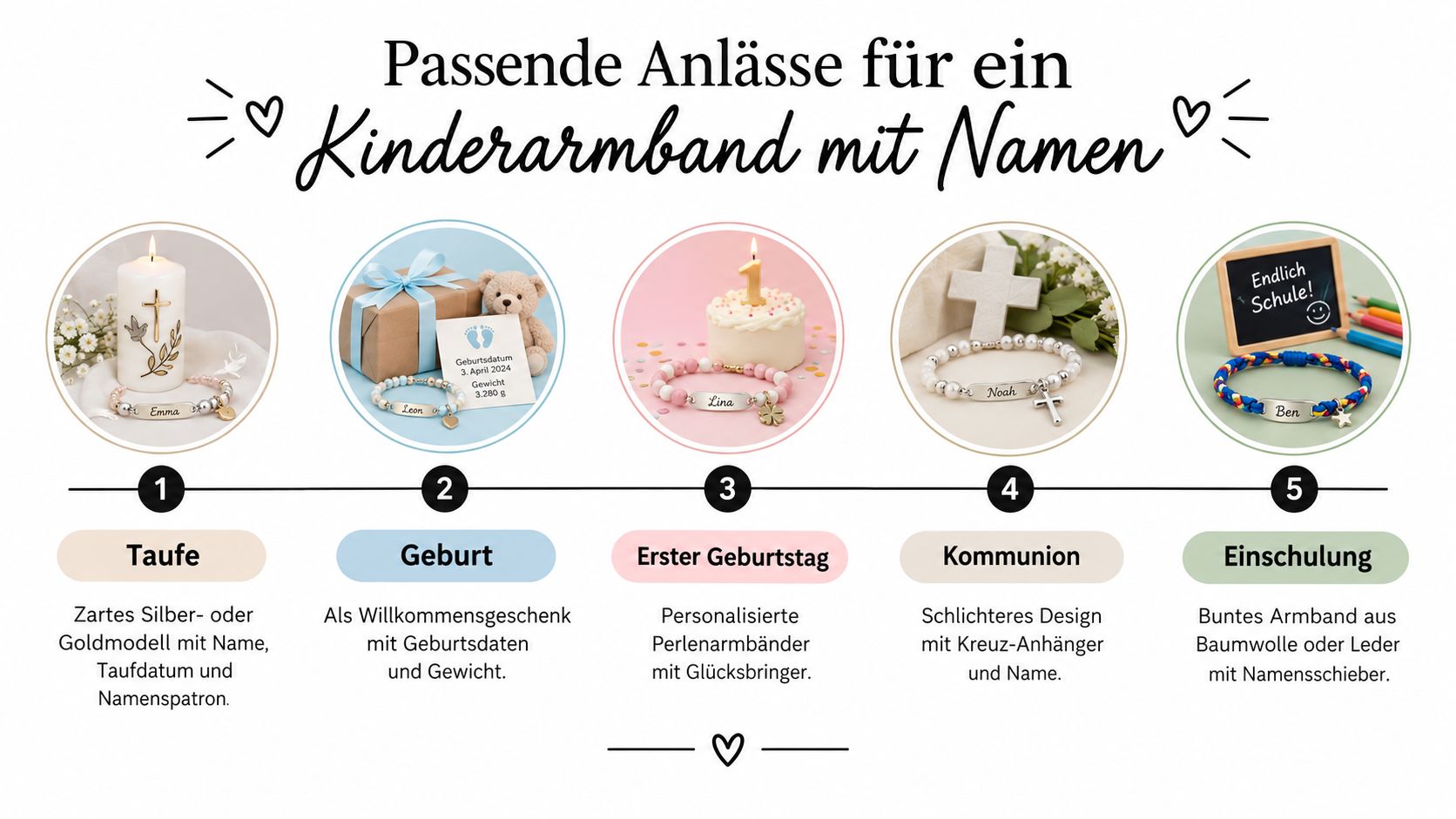
For starting school, the model should be able to withstand more. A more durable bracelet engraved with the name, school, or year of starting school can accompany the child in their new routine, but should be protected before sports and classes involving a lot of movement. For gifts from siblings or grandparents, matching bracelets work well when each piece has its own engraving.
| Occasion | Suitable style | Meaningful engraving |
|---|---|---|
| Baptism | Delicate silver or gold | Name, baptism date, symbol |
| Birth | Simple and timeless | Name, date of birth |
| First birthday | Playful and colorful | Name, motif, date |
| First Communion | Subtle and festive | Name, date, small religious symbol |
| Starting school | Durable and practical for everyday use | Name, school, or year of starting school |
| Gift from siblings or grandparents | Matching set or coordinated models | Name and short personal text |
For a First Communion, a minimalist design with a small cross pendant may be suitable. You can find ideas for a festive style in the article about First Communion jewelry for girls.
The packaging helps shape the moment. A sturdy gift box protects the bracelet when it is presented, a card explains the meaning of the engraving, and a small note with the ordered text helps with checking. For a functional bracelet, you should also tell the recipient's family what information was engraved and when the details need to be updated.
Care instructions and delivery times at a glance
To keep a personalized children's bracelet looking beautiful for a long time, it should be removed before bathing, swimming, and sports. Pearl, leather, and stainless steel bracelets can usually be cleaned with a soft, slightly damp cloth. Chlorine, salt water, sweat, perfume, and cleaning products can damage the material and surface.
Gold-plated or silver-plated models require extra care. Do not rub vigorously, avoid harsh polishing agents, and store the bracelet in a dry place. A jewelry box protects it from scratches caused by other items.
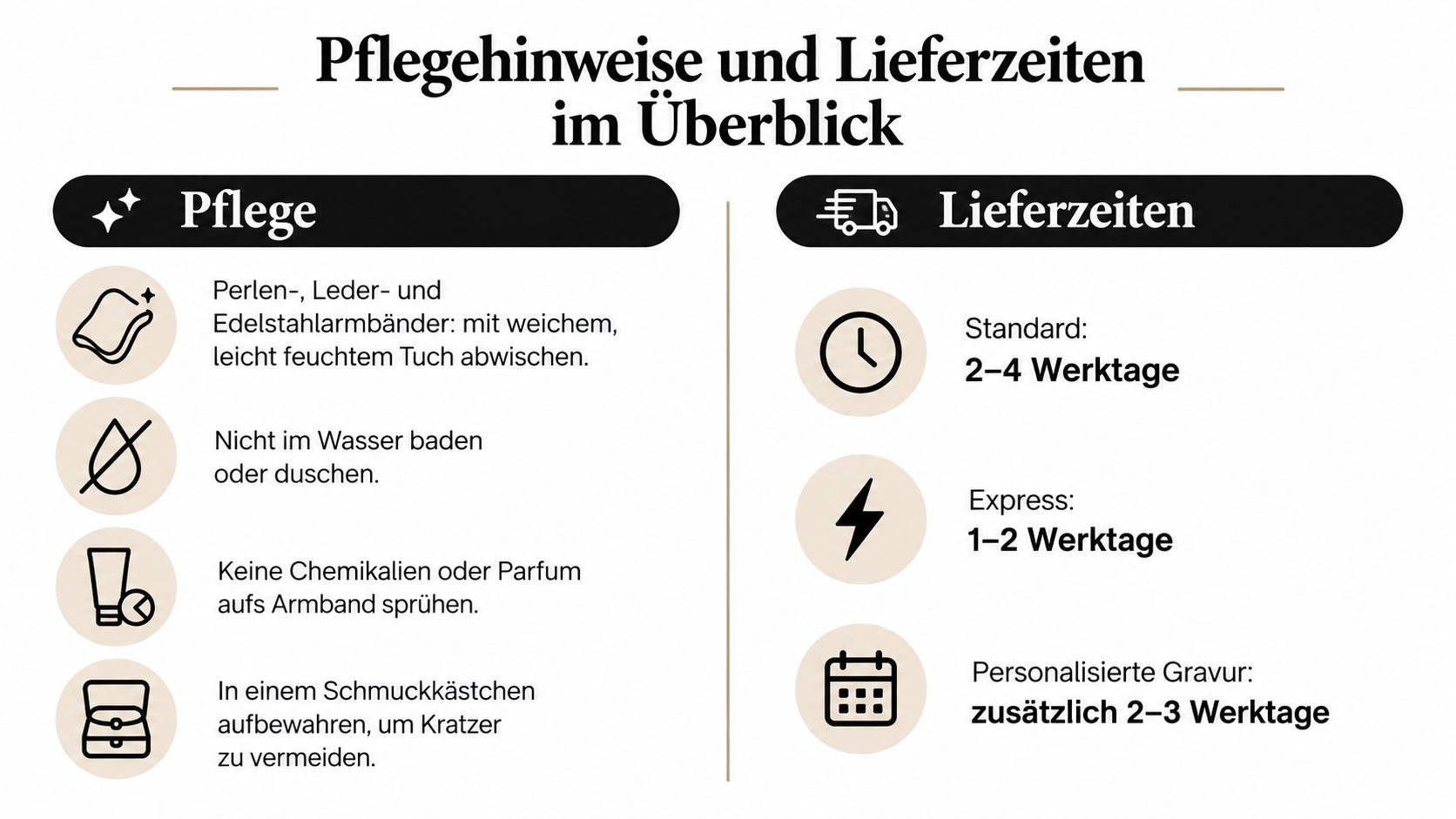
Care check: Regularly check the clasp, loops, engraving area, and coating. If an edge becomes sharp or a part is loose, the child should stop wearing the bracelet. This check is particularly important for a bracelet with identification or allergy information, because the information must remain legible.
Allow sufficient lead time for personalized jewelry. The delivery time depends on the engraving effort, the production facility, and the season. Check whether the stated timeframe already includes personalization or begins only after production.
Standard shipping is sufficient for an event that is still some time away. Express shipping is suitable for an upcoming date, provided the production time is explicitly taken into account. Clear information about delivery times, care, warranty, and cancellation rights makes ordering easier. You can find another gift idea for a birth in the guide to personalized birth gifts.
OTANTO offers handcrafted customizable jewelry from Germany, including engraved bracelets and gift packaging. Before ordering, check the material, size, engraving text, and delivery time.


