


Understanding 585 gold jewelry and choosing it correctly
You may be sitting there right now with several browser tabs open. One shows a delicate name necklace, the next a ring with an engraving, and the third explains something about 333, 585, and 750. And somewhere, the same question always comes up: Is 585 gold simply just a number, or is it exactly the right choice for jewelry I want to wear every day?
This is exactly where many descriptions fall short. They tell you the gold content, but not how that feels in real life. Can an engraved necklace withstand everyday wear? Is a Couple bracelet in 585 more sensible than one in 333? And is 750 really worthwhile if the piece is not going to lie in a jewelry box, but is meant to be worn on you constantly?
I will explain it to you the way I would at the workbench. Not as dry alloy theory, but as a practical decision for hands, skin, movement, and memories.
Table of contents
- Why jewelry made of 585 gold is so often the first choice
- What the 585 hallmark really means and how it is created
- Properties of 585 Gold for Everyday Wear
- 585 Gold Compared with 333 and 750
- Care and durability so engravings stay beautiful for a long time
- How to properly assess the price and value of jewelry made of 585 gold
- Conclusion and recommendation for your 585 gold jewelry from OTANTO
Why jewelry made of 585 gold is so often the first choice
You are holding two pieces of jewelry that are almost identical. One necklace is cheaper; the other bears the small number 585. At first glance, the difference seems small. For everyday wear, it can be very significant.
That is exactly why many people first choose jewelry made of 585 gold. Not because it is a particularly impressive number, but because this alloy offers a balanced combination of value, durability, and price in many everyday situations. Especially for jewelry that is not worn only on holidays, but put on in the morning and often still worn at night.
With engraved jewelry and couple jewelry, something else matters than with a piece for special occasions. A ring with a date rubs against the steering wheel, bags, and door handles. A name necklace moves with you while you sleep, shower, get dressed, and work. A Couple bracelet should show closeness without making you constantly worry about the material. For precisely these wearing patterns, 585 gold is often the sensible choice.
The real buying decision behind the hallmark
Many people look at 333, 585, or 750 and search for the highest number, as if that automatically meant the best choice. At the workbench, things look different. The better choice is usually the one that suits your life.
Three questions can help:
- Do you wear the piece every day or only occasionally? Everyday jewelry needs to withstand more wear and tear.
- Should an engraving remain clearly legible for a long time? Then the gold content is not the only important factor; how suitable the material is for everyday wear overall also matters.
- How important is the relationship between the purchase price and the length of use to you? A piece of jewelry that is worn often must justify its price in everyday life.
For many people, 585 strikes a balance here, and in the best sense. 333 is often less expensive and may be suitable when the budget is tight or the piece is worn less often. 750 has a higher gold content and a particularly rich appearance, but for engraved or matching jewelry worn every day, it is not automatically the smarter choice. Those looking for something solid, valuable and affordably lasting for everyday wear therefore often choose 585.
Why 585 is so often the convincing choice for personalized jewelry
An engraving makes jewelry more personal. At the same time, it makes the decision more demanding. After all, an engraved piece is not as easy to replace as a simple accessory.
585 gold is chosen so often because it brings sentimental value and everyday practicality together better than many buyers initially expect. It looks high-quality without causing concern at every small movement. This is often the point with simple rings, pendants, matching necklaces and bracelets where a beautiful idea becomes a piece of jewelry that can truly be worn for a long time.
In short: If you want not just to buy gold, but a piece for many ordinary days, choosing 585 is often the calmer and more sensible decision in the long term.
What the 585 hallmark really means and how it is created
You turn a ring in your hand, look for the small number inside the band and wonder whether these three digits really say anything about everyday life with the piece of jewelry. That is exactly what the hallmark is for. It is not a decorative detail, but a brief answer about the material to a practical purchasing question.
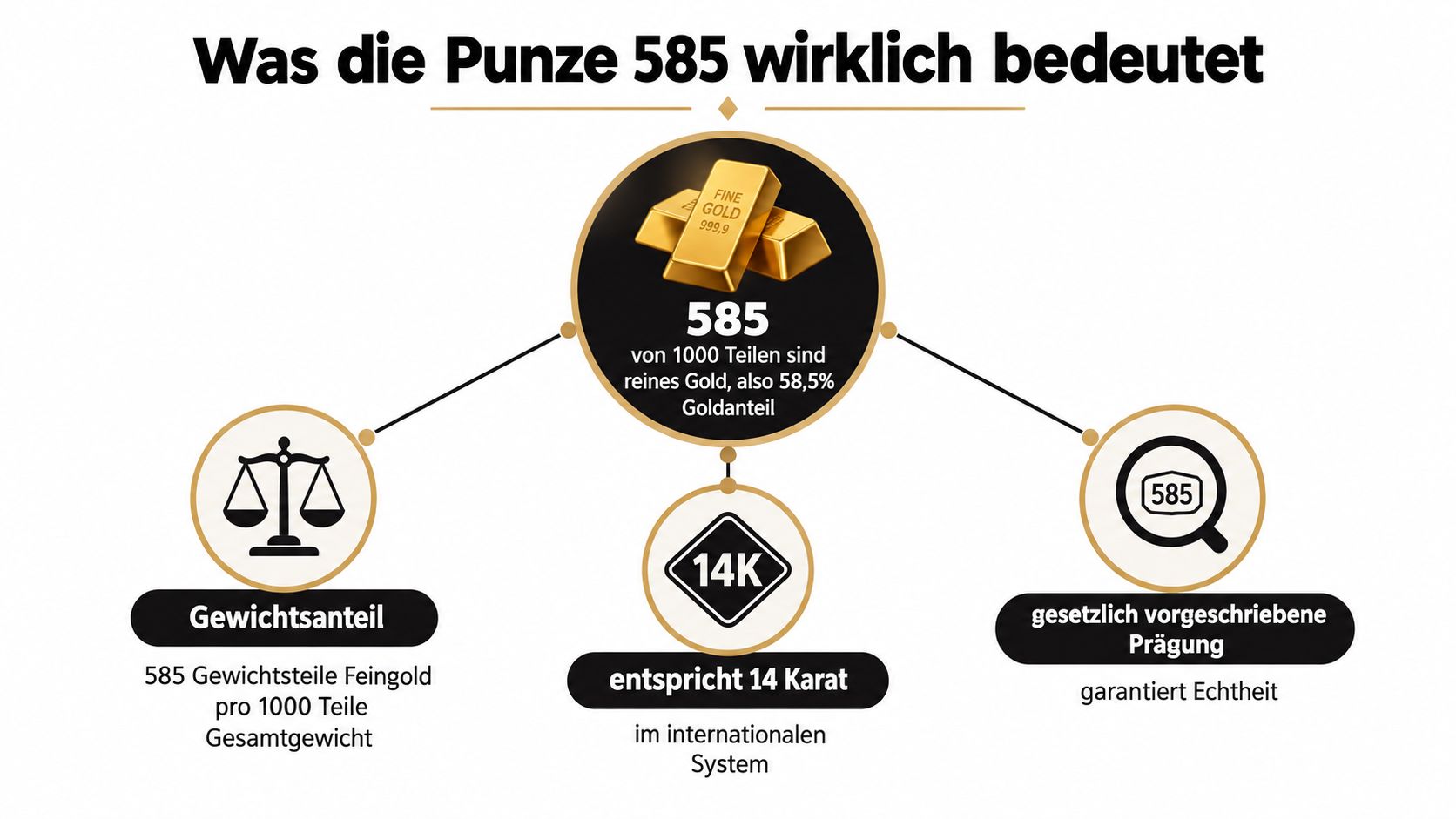
585 describes the gold content very precisely
585 means: Of 1,000 parts of the material, 585 parts are pure gold. The remainder consists of other metals, such as silver, copper or palladium. Internationally, this corresponds to 14 karats.
A simple workshop image helps explain it. Pure gold behaves a little like very soft wax. It feels precious and is easy to shape, but gives way more quickly under strain. Mixing it with other metals creates a material that is better suited to rings, pendant charms or fine engraving plates.
The hallmark therefore reveals not only that gold is present. It also shows the balance between value and suitability for everyday wear.
How 585 Gold Is Made
It starts with pure gold. The metals that give the alloy its later properties are added to it. More copper can make the tone appear warmer. Silver or palladium can make the gold appear lighter. This is how yellow gold, rose gold, or white gold are created, even though the hallmark can be identical when the fineness is the same.
After mixing, the metal is melted, cast, and further processed, for example into wire, sheet metal, or a ring blank. The hallmark is only applied to the finished piece of jewelry, stamped in an inconspicuous place or added by laser, for example on the inside of a ring or on the clasp of a necklace.
Key point: The 585 hallmark tells you how much gold is contained in the piece. The color tells you which metals are also contributing.
Why This Small Number Is So Useful for Buyers
In the German jewelry market, fineness marks in thousandths are standard. The introduction to gold hallmarks and the marking of gold jewelry explains this system well. For you as a buyer, one thing is particularly important: The hallmark clearly distinguishes genuine alloyed gold from a merely gold-colored surface.
This is especially useful for engraved and matching jewelry. Such pieces are often worn close to the body, frequently for years, and rarely kept completely worry-free in a drawer. The small 585 stamped into the metal is therefore more than a technical specification. It often marks exactly the point at which a piece of jewelry has sufficient gold value while remaining stable enough for regular wear.
At first glance, 333, 585, and 750 may sound like nothing more than steps on a numerical scale. In practice, they represent a material choice. Someone who wears a ring only occasionally evaluates this number differently from someone who looks at an engraving every day, keeps the ring on while working, or puts on a matching necklace every morning.
A short video also illustrates this basic idea:
Properties of 585 Gold for Everyday Wear
In everyday life, it's not just what is stamped on the piece that matters. What matters is how the piece holds up after weeks and months. This is exactly where 585 gold shows its strength.
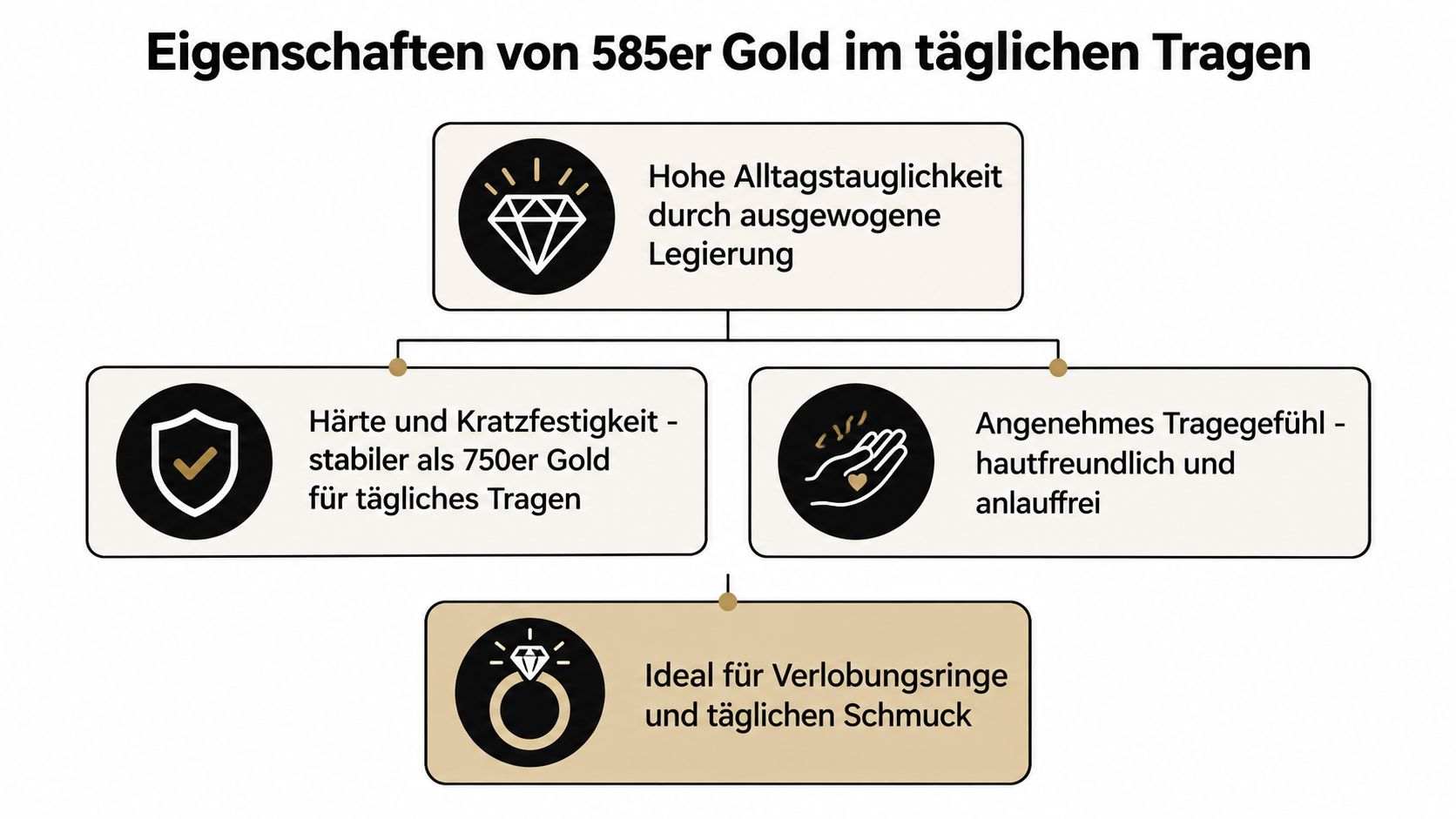
How 585 Gold Performs in Real Life
In the German jewelry market, 585 is considered the common standard for everyday jewelry because the alloy offers a practical balance between value, durability, and workability. Expert information on 333, 585, and 750 in karat comparison highlights this exact combination.
This may sound technical, but it is easy to notice. A 585 gold ring feels high-quality without being unnecessarily delicate in everyday use. A 585 gold necklace remains fine and elegant, but is better suited to regular wear than alloys that are softer and contain more gold.
Typical Wearing Profiles
Not everyone wears jewelry in the same way. That is why there is no blanket answer of “better” or “worse”; it is more useful to look at your habits.
- Office and Everyday Wear: You put your necklace on in the morning and take it off in the evening. It touches clothing, skin, and perhaps occasionally your scarf or zipper. 585 gold is very well suited to this.
- Active Hands: With rings and matching bracelets, edges are more likely to bump against tabletops, door handles, or bag fasteners. This is where everyday durability is especially helpful.
- Memorial Jewelry with Engraving: The more often an engraved piece is worn, the more important it is to choose a material that not only looks beautiful but also stands up well to everyday wear.
Anyone interested in a heart necklace or a small pendant can get a feel for these practical everyday designs, for example, with a heart necklace.
A piece of jewelry is well chosen when you do not have to constantly think about its sensitivity while wearing it.
Where the Limits Lie
Suitable for everyday wear does not mean indestructible. 585 gold can also get scratched. This applies especially to highly polished surfaces and pieces that come into frequent contact with other objects.
It is also important to note that showers, sports, gardening, or swimming pools are not ideal stress tests for engraved jewelry. Many people wear their necklace almost all the time. That is understandable. However, anyone who wants to enjoy it for a long time should still not treat it like a key ring.
Why 585 Gold Is Often Such a Good Choice for Personalized Pieces
Engravings rely on clear surfaces and cleanly worked edges. This requires a material that can be processed precisely and remains well suited to everyday use. That is exactly why 585 gold is so popular for name necklaces, pendants, and simple rings. It offers a genuine gold feel without overlooking the practical aspects of wearing it.
585 Gold Compared with 333 and 750
This is where the actual decision lies. Not everyone needs the same alloy. Those who focus only on the highest karat count sometimes choose jewelry that is unsuitable for everyday use. Those who focus only on the most affordable entry point may be saving in the wrong place.
The three common alloys in Germany
In German jewelry, you will encounter 333, 585, and 750 in particular. This classification has developed historically and is firmly established in the fineness system, as already described for German hallmarks. For buyers, what this means in practice is more important: more gold does not automatically mean the smarter choice for every occasion.
Gold alloys 333, 585, and 750 compared directly
| Feature | 333 gold (8 karat) | 585 gold (14 karat) | 750 gold (18 karat) |
|---|---|---|---|
| Gold content | Lower gold content than 585 | 58.5% gold content | Higher gold content than 585 |
| Classification | Entry-level option in gold jewelry | Common standard for everyday jewelry in Germany | Higher-grade gold alloy |
| Color impression | Often somewhat more understated in gold character | Balanced and classic | Often richer and more golden in appearance |
| Suitability for everyday use | Can feel sturdy, but with lower gold value | Very well balanced for everyday wear | Valuable, but often more delicate in everyday use |
| Engraved and matching jewelry | Possible, but often chosen primarily for price reasons | The best middle ground for many | More suitable for people who consciously prioritize gold content |
| Purchase motivation | More affordable entry point | Balance between gold value and use | More gold, a greater sense of luxury |
When 585 is better than 333
For some purchases, 333 is simply the budget option. That is not automatically wrong. If the budget is very limited and the piece should still be real gold, 333 can make sense.
For a gift with great emotional significance, many people prefer 585. The reason is simple: You get a noticeably stronger gold character without immediately moving into the softer and usually more expensive 750 category. This is often the most harmonious middle ground, especially for matching pieces or a chain with a pendant. Anyone who would like to look at such styles can get a good feel for how strongly material and design work together with a gold chain with pendant.
When 585 is better than 750
This is where the most common uncertainty lies. Many people think: If 750 contains more gold, it must automatically be better. That is only true if higher gold content is genuinely your most important goal.
585 is often the smarter choice if you:
- you wear every day and not just on special occasions,
- Engravings or personalization you want,
- Delicate designs you prefer,
- Price and use you want to keep in sensible balance.
750 is more suitable if you want to place particular emphasis on the material itself. That is, when the higher gold content, often richer appearance, and more luxurious feel appeal to you more than maximum practicality for everyday use.
For a ring that works with your hands every day, the alloy with the highest gold content is not automatically the most sensible choice.
Care and durability so engravings stay beautiful for a long time
An engraved piece of jewelry ages differently from a smooth one. Not worse, but more visibly. Every touch, every instance of friction, and every storage method affects the surface and engraving. The good news is that with a simple routine, 585 gold remains very wearable and beautiful.
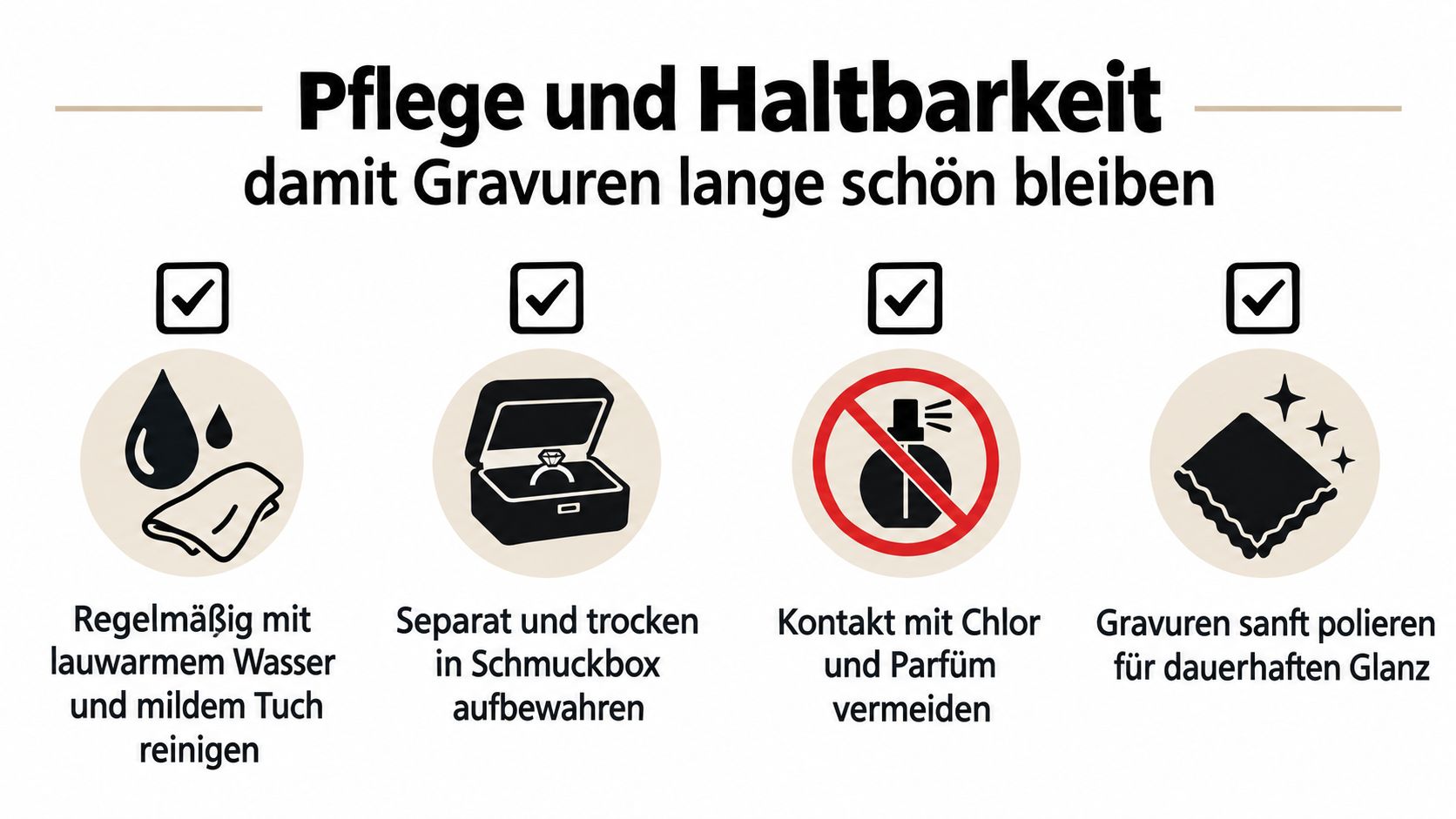
The small daily routine
Many types of damage are not caused by a single major event, but by constant little things. Perfume on the necklace. A ring and keys in the same bowl. A bracelet during sports. It all adds up.
This is how engraved jewelry stays beautiful longer:
- Clean gently: Lukewarm water and a soft cloth are usually more than enough for everyday care. Do not rub hard over engraved surfaces.
- Store separately: Necklaces, rings, and bracelets should not rub loosely against one another. A jewelry box or a soft pouch helps.
- Keep cosmetics at a distance: It is better to apply cream, perfume, and hairspray before putting on your jewelry.
- Take it off during strenuous activities: Sports, gardening, swimming, and cleaning are typical situations in which jewelry suffers unnecessarily.
Practical rule: The engraved piece can be your everyday jewelry. It just should not have to solve every everyday problem too.
What best protects engravings
With an engraving, it is not just the shine that matters, but also the legibility. Names, dates, or short messages depend on clear lines. That is why caution with aggressive cleaners makes sense. Polishing one spot too intensely is also not a good idea, as it can put uneven strain on the surface.
If you wear a name necklace or couple bracelet often, check the clasps, loops, and connecting parts at regular intervals. Not out of concern, but out of common sense. These small components in particular do most of the work in everyday use.
Durability is also a matter of use
A ring on the dominant hand experiences more than a pendant on the décolletage. A tight bracelet undergoes different friction than a loosely hanging chain. That is why there is no general formula for how long jewelry lasts. There are only good habits.
Anyone who gives engraved jewelry as a gift is therefore giving not only a material but also a small responsibility for its care. That sounds matter-of-fact, but it is something beautiful. Keepsakes often stay with us for a long time precisely when we treat them with care.
How to properly assess the price and value of jewelry made of 585 gold
When looking at the price, many people first look at the karat number and then at the label. That is not enough. The price of a piece of jewelry never consists only of the gold.
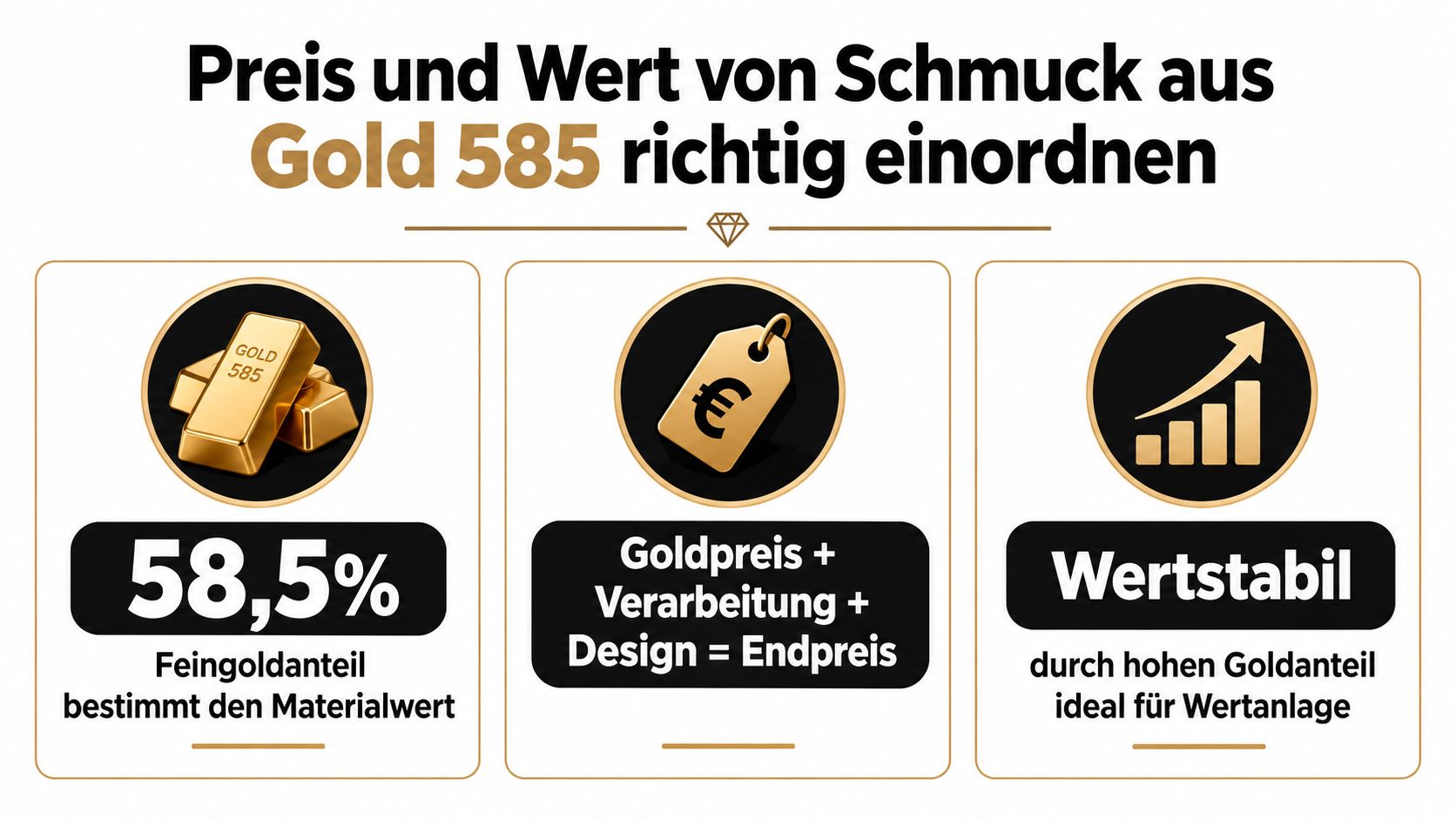
What makes up the price
With jewelry made of 585 gold, you pay for several things at once:
- the gold content of the alloy,
- the workmanship,
- the design,
- for personalized pieces, the engraving or custom production,
- and, depending on the provider, also for service, packaging, and shipping.
That is why an engraved pendant is not simply “gold by weight.” It is a finished object with material value and craftsmanship. When comparing offers, you should therefore always ask: Am I paying only for the alloy here, or also for the shape, personalization, and quality of the workmanship?
What the material value means in practice
Many guides remain vague here. A German reference value from the gold-buying market makes it more tangible: for 585 gold jewelry, a current reference value is 67.25 euros per gram, as explained in the overview of buying 585 14K gold alloy.
This does not mean that every piece of jewelry is automatically “worth” this amount. Buying gold is different from selling it, and finished jewelry always includes labor and design costs as well. But this value shows something important: 585 is not only emotional but also objectively classifiable in terms of its material.
Why this matters for gifts
Personalized gifts in particular involve a dual consideration. On the one hand, the piece should feel personal. On the other hand, many people want to give something that does not seem arbitrary. 585 often meets this idea well: enough gold content to provide a clearly valuable material feel, while still being practical enough for real everyday use.
When choosing a pendant, name necklace, or engraved gift, you can also take inspiration from the design language of a gold necklace with pendant.
A provider like OTANTO offers handcrafted, customizable jewelry from Germany, including a 585 gold collection related to engraving. For buyers, it is objectively interesting that personalization and material can be considered together here.
Value in jewelry has two dimensions. One can be found in the material. The other is carried by the person who gives or wears it.
Conclusion and recommendation for your 585 gold jewelry from OTANTO
If you’re looking for a piece that should not only make an impact when it is given as a gift but also stand up to everyday wear, 585 gold jewelry is often the most sensible and, at the same time, very appealing choice. Not because 585 is always “the most,” but because this alloy suits many real-life wearing situations.
For engraved pieces worn daily, name necklaces, Couple bracelet, and simple rings, 585 is particularly well suited. Compared with 333, it generally feels more valuable in terms of the material. Compared with 750, it is often more practical when a piece is worn regularly rather than reserved only for special moments.
A simple decision guide can help:
- You want a keepsake gift for everyday wear: 585 is usually a very suitable choice.
- You’re primarily looking for a more affordable entry point into genuine gold: Then 333 may be an option.
- You prioritize a higher gold content and a more luxurious material feel: Then it’s worth looking at 750.
For occasions such as a birth, anniversary, Mother’s Day, or a gift for your partner, 585 is so convincing because it combines sentiment with practicality. Especially with personalized pieces, that is often more important than the highest number on the hallmark.
When choosing, don’t focus only on karat. Consider how the piece is meant to be worn. That is usually where the right decision becomes clear.
At OTANTO, you’ll find handcrafted, customizable jewelry from Germany, including name necklaces, Couple bracelet, engraved gifts, and a 585 gold collection. If you’re looking for a piece that feels emotional while remaining practical for everyday wear, it’s worth exploring the selection and the various personalization options.


